
15 Dishes You Need to Try
Honest descriptions, pronunciation guides, where to find each dish, and how to order without embarrassing yourself
Ghanaian food is one of the most genuinely underrated culinary traditions in the world, and it is absolutely one of the highlights of visiting. It is not fussy. It does not try to be clever. It is deeply satisfying, often fiery, built on excellent ingredients — fresh fish, plantain, yam, tomatoes, groundnuts, and scotch bonnet peppers — and it has been perfecting itself for centuries without needing anyone else’s approval.
For British visitors, the adjustment involves two things: unfamiliar textures and significantly higher heat levels than most UK food. The textures — the smooth stickiness of fufu, the sour fermented edge of banku, the dense mealiness of kenkey — take a meal or two to get used to and then become deeply appealing. If you’re still planning your trip, our Ultimate Ghana Travel Guide covers everything from Accra to the north — but come back here when it’s time to eat.
This guide covers 15 dishes worth seeking out, from the essential staples to the street food snacks to the regional specialities that most visitors miss. Each entry includes a pronunciation guide, what it tastes like honestly, where to find it, and how much to expect to pay.
Scotch bonnet peppers are the default seasoning across Ghanaian food. When ordering, ‘small pepper’ is the polite way to ask for less heat — but even ‘small pepper’ will be noticeably hotter than a standard British curry house medium. If you have a very low spice tolerance, say ‘very small pepper please’. Ghanaians find ‘no pepper’ a slightly strange concept but will try their best.
Ghanaian food operates on a simple and consistent principle: a starchy base paired with a soup or stew, almost always with a protein. Understanding this structure makes the menu at any chop bar immediately legible.
The starchy base is chosen from: fufu, banku, kenkey, omo tuo (rice balls), or plain boiled rice. The soup provides most of the flavour — groundnut soup, light soup, palm nut soup, or okra stew. At a chop bar you’ll typically be asked: “What soup?” and “What swallow?” — swallow is the collective term for fufu, banku, and similar foods, so named because you swallow rather than chew them. For a broader look at what Ghana has to offer visitors, see our Ghana Travel Tips Guide.
In Ghanaian culture, the left hand is considered unclean and food is always eaten with the right hand. This applies whether you are at a chop bar, a family home, or a roadside stall. Use your right hand to break off fufu and scoop soup. Your left hand stays in your lap.
Jump to any dish
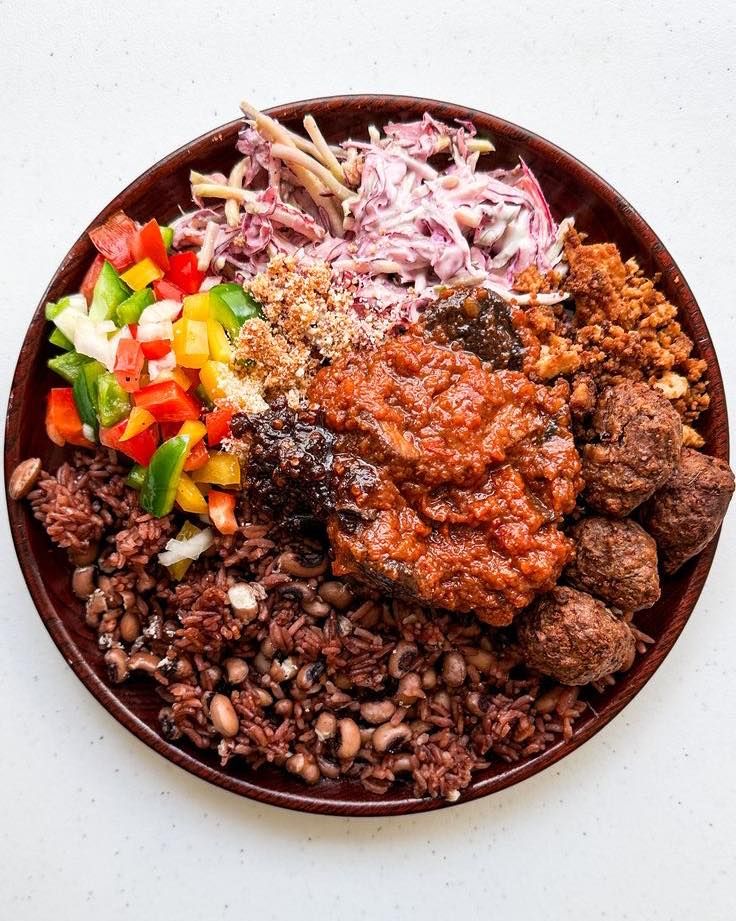
Waakye is rice and beans cooked together with dried sorghum or millet leaves, which turn the whole thing a distinctive deep reddish-brown. What makes waakye extraordinary is not the base — it is the assembly. A proper plate arrives with: tomato stew, shito (black pepper sauce), fried plantain, a hard-boiled egg, gari (dried grated cassava), spaghetti (yes, spaghetti — it is a thing), avocado if in season, and your choice of fried fish or meat. It is, in one plate, almost everything that is good about Ghanaian cooking.
If you eat one local meal in Ghana, make it waakye. Find the longest queue of Ghanaians and join it — the queue is the quality signal at any waakye stall. We dedicated a whole section to it in our Ghanaian Breakfasts guide — it is that good.
Jollof rice is rice cooked directly in a seasoned tomato and pepper sauce until every grain is infused with smoky, savoury flavour. Done well — and in Ghana it frequently is — it has a slightly crispy bottom layer that Ghanaians prize and which is, frankly, the best bit. Served with fried or grilled chicken, beef, or fish, and usually accompanied by fried plantain and a simple salad.
The Jollof Wars — the ongoing, semi-serious debate between Ghana and Nigeria about who makes the superior version — is worth raising with any Ghanaian you meet. They will immediately and confidently tell you Ghana wins. The full 30-dish Ghana food guide on this site goes deeper into the jollof debate if you want the full picture.
Banku is a fermented mixture of corn dough and cassava dough, cooked until it forms a smooth, slightly sour, slightly elastic ball. The fermentation gives it a tangy edge — somewhere between a very mild sourdough and a corn dumpling. It is the default pairing for grilled tilapia along Ghana’s coast, and together they are one of the great culinary combinations of West Africa.
The tilapia arrives whole, grilled over charcoal until the skin is charred and the flesh pulls away cleanly. It comes with a fresh pepper sauce and shito on the side. Banku and tilapia is best eaten near Cape Coast or at any Accra beach chop bar — the combination of charcoal smoke and sea air makes the experience complete.
Fufu is made by pounding boiled cassava and plantain together until the mixture becomes a smooth, stretchy, completely homogeneous dough. The result is dense, slightly elastic, and almost entirely flavourless on its own. That is the point. Fufu is a vehicle for soup, not a dish in itself.
Light soup is a thin, tomato-based broth that is anything but light in flavour — intensely peppered, with goat, chicken, or fish adding depth. You do not chew the fufu — you swallow it. This takes about one meal to get used to and then becomes instinctive. Our dedicated article on how to eat fufu like a true Ghanaian walks you through the full ritual — well worth a read before you sit down at a chop bar. There’s also a deeper piece on why fufu holds such a special place in Ghanaian culture.
Kenkey is a fermented corn dumpling — the Ga people of Accra’s most fundamental food. Fermented corn dough is formed into balls, wrapped in dried corn husks or banana leaves, and steamed until firm. The result is dense, very slightly sour, and deeply filling. Comes in two types: Ga kenkey (corn husks, common in Accra) and Fante kenkey (banana leaves, Cape Coast area — slightly softer and milder).
Texture challenges visitors for one or two meals and then something clicks. Served with fried fish and a fierce pepper sauce, it is exceptional coastal food. The Fante kenkey is best tried during a visit to the Central Region — pair it with a day trip to Kakum National Park and eat at the roadside chop bars on the way back.
Fried ripe plantain spiced with ginger, garlic, and scotch bonnet pepper. The plantain is cut into chunks, tossed in the spice mix, and fried until caramelised and slightly charred at the edges. The result is sweet, spicy, fragrant, and more-ish in a way that makes it difficult to stop eating.
Kelewele is primarily an evening food, sold from oil drums converted into frying stations by women working under streetlights across Accra and Kumasi. Buying a paper packet from a vendor and eating it in the warm dark while the city moves around you is one of those genuinely memorable small experiences. Look for kelewele stalls in Osu — the same neighbourhood covered in our Accra neighbourhood guide.
Shito is not a dish — it is a condiment, a sauce, a philosophy. Made from dried fish or prawns, scotch bonnet peppers, ginger, garlic, and various spices, all fried down in oil until dark and intensely flavoured, shito is the Ghanaian equivalent of ketchup — except wildly more complex and approximately ten times hotter. It accompanies waakye, rice, banku, kenkey, fried yam, eggs, bread — essentially anything edible.
The heat builds rather than hits immediately. A jar of shito is one of the best souvenirs you can bring home from Ghana. In the UK, you can find it at GH Foods and select African grocery shops in London and Birmingham — but the fresh market version is significantly better.
Black-eyed peas cooked in a rich palm oil and tomato stew, served with fried ripe plantain. The name comes from the red of the palm oil and the red of the tomatoes. Sweet and slightly caramelised plantain alongside earthy, smoky beans in a sauce that has warmth but not ferocity. Naturally vegetarian and one of the most approachable entry points into Ghanaian food for visitors who find the fermented starchy bases more challenging on day one.
Red red proves that Ghanaian food does not require unfamiliar textures to be deeply satisfying. It also appears regularly on the Ghanaian breakfast circuit — a gentler start to the day if you’re working your way up to waakye.
Made from pounded roasted peanuts dissolved into a tomato and pepper broth, with chicken or goat providing the protein. The result is thick, richly flavoured, and deeply satisfying — with natural sweetness from the peanuts, heat from the scotch bonnet, and a savoury depth that only slow-cooked groundnuts produce.
For British visitors, it occupies a space somewhere between satay sauce and a Thai peanut curry — except older, more direct, and with significantly more chilli. Pairs traditionally with fufu (see dish #4 above), though excellent with rice or omo tuo. Groundnut soup is particularly celebrated in Akan culture — it is the social glue of a Sunday afternoon.
Small pieces of beef, goat, or chicken coated in a dry spice rub of ground peanuts, ginger, and chilli, then grilled over hot coals on wooden skewers. The outside chars slightly, the spice rub forms a crust, and the meat inside stays tender. Served with raw onion slices and chilli sauce.
Quintessential evening street food — appearing at nighttime markets, outside bars, and at Accra and Kumasi roadsides from around 7pm. The smell of it grilling is one of the atmospheric signatures of a Ghanaian evening. Chinchinga vendors are mostly northern Ghanaian Muslims — masters of the grill with generations of technique behind them. Order three or four skewers with a cold Club beer.
Boiled yam, plantain, or cassava served with kontomire stew — made from tender cocoyam leaves (similar to spinach or kale) cooked with palm oil, tomatoes, onion, salted fish, and boiled eggs. Rich without being heavy, with the boiled starchy vegetables providing a perfect counterpoint. Avocado comes on the side when in season. Almost entirely naturally gluten-free.
Ampesi is food that makes you feel properly nourished rather than overwhelmed. One of the most approachable dishes for visitors still finding their footing. For context on the cultural significance of Akan food traditions that ampesi sits within, our piece on Ghanaian cultural traditions gives useful background.
Soft, overcooked rice moulded into smooth balls — a gentler, less demanding alternative to fufu for visitors who want to participate in the soup-and-swallow tradition without fufu’s full texture commitment. The rice balls absorb soup well and remain approachable for newcomers.
Particularly popular on Sundays, when families cook large quantities of groundnut or palm nut soup and the meal becomes a communal, leisurely affair. If you find yourself at a Ghanaian home on a Sunday, omo tuo and groundnut soup is likely what is on offer. It will be very good. Sunday lunch in Ghana is a genuine cultural institution — for more on how Ghanaians mark their days and traditions, see our piece on Ghanaian cultural celebrations.
A deep ruby-red drink made from dried hibiscus flowers steeped with ginger and sometimes cloves or cinnamon. Tart, refreshing, fragrant, and completely natural. Ice cold on a hot Accra afternoon, it is one of the most satisfying drinks in existence. In the UK it is sold as ‘bissap’ or hibiscus cordial — the Ghanaian version, made with more ginger and less sugar, is significantly better than any commercial approximation.
Sold in small plastic bags knotted at the top, in recycled bottles, and freshly poured at market stalls. Costs almost nothing. Drink it at every opportunity. The BBC Good Food hibiscus drink recipe is a reasonable attempt at the style if you want to recreate it at home — though nothing truly substitutes the original.
Made from corn or millet flour cooked until very thick and soft — smoother and less sticky than fufu, making it a slightly easier introduction to swallow foods for visitors. Eaten the same way: torn into small balls with the right hand and used to scoop soup.
Almost always served with ayoyo soup (from jute leaves, slightly mucilaginous) or with dawadawa-spiced soups that have a distinctive, intensely savoury flavour from fermented locust beans. This is northern food with a completely different profile from southern Ghana — less palm oil, more grains. TZ is best experienced in context: plan a trip to Tamale and combine it with a visit to Mole National Park, Ghana’s best wildlife destination, just a few hours north.
A young green coconut, macheted open at the top by a roadside vendor with the calm efficiency of someone who has done it twenty thousand times, handed to you with a straw. The water inside is cool, naturally sweet, and slightly grassy in the best way — nothing like the processed coconut water sold in UK supermarkets.
When you have finished drinking, the vendor slices it open and uses a piece of the shell to scrape out the young jelly coconut flesh, which is soft and mild and extraordinary. At GHS 5–10, it is the most consistently satisfying purchase available in Ghana. Coconut vendors are most plentiful along the coast — you’ll pass them constantly on the drive between Accra and Cape Coast. Stop every time.
Walking into a chop bar as a first-time visitor is slightly intimidating for about four minutes and then entirely natural. Here is what to expect.
| What is a chop bar? | A simple local restaurant — plastic tables and benches, a chalkboard or no menu, and a cooking area with large pots. Approach the cooking area to see what is available and order there, or a server comes to you. |
|---|---|
| The question you’ll be asked | “What will you take?” or “What soup?” and “What swallow?” — choose your base (fufu, banku, rice, omo tuo) and your soup (light, groundnut, palm nut, okra). They will confirm the protein available. |
| Asking for less spice | “Small pepper please” — this requests less heat, but it is relative. Say “very small pepper” for sensitive palates. ‘No pepper’ confuses people. |
| Portion sizes | Large by UK standards. Ask for “small” if not very hungry — it will still be a proper portion. |
| Hand washing | Many chop bars have a hand washing bowl — use it before eating. Bring hand sanitiser as backup. |
| Payment | Cash only at most local places. Have small denominations. Prices are usually quoted upfront. For money tips, see our full Ghana budget guide. |
| Useful Twi phrases | Medaase (meh-DAH-see) = thank you. Chale (CHAH-lay) = friend/mate. Using either generates significant goodwill. For more language tips, BBC Languages has a useful intro to West African phrases. |
- Eat at chop bars and street stalls that are visibly busy — high turnover means fresher food. A stall with a queue of Ghanaians is always safer than an empty one.
- Choose cooked food served fresh and hot. The heat kills pathogens. Avoid food sitting out for extended periods.
- Fruit you peel yourself is safe. Unpeeled raw fruit or vegetables washed in unknown water carry more risk.
- Drink only bottled water or sobolo from sealed containers. Avoid ice from unknown sources. The NHS travel health advice covers what to do if you do get an upset stomach abroad.
- Your stomach may take 2–3 days to adjust. Mild digestive disruption in the first few days is common and not alarming. Carry oral rehydration sachets.
- If you have a very sensitive stomach, start with hotel or mid-range restaurant food on day one, then gradually introduce chop bars and street food from day two. See our Ghana travel health tips for the full picture including vaccinations and medical facilities in Accra.
The Most Important Thing:
Eat Outside
Do not spend your Ghana trip eating in hotel restaurants. The hotel restaurant exists for people who are afraid to leave it.
The real food is outside — at the waakye stall at 8am, at the chop bar at lunch, at the kelewele vendor at 9pm, at the beachside tilapia grill whenever you can find one. Ghanaian food is one of the genuine highlights of visiting, and it costs almost nothing to eat exceptionally well.
Stay curious, eat with your right hand, say ‘small pepper’ early and often, and let Ghana feed you properly.