
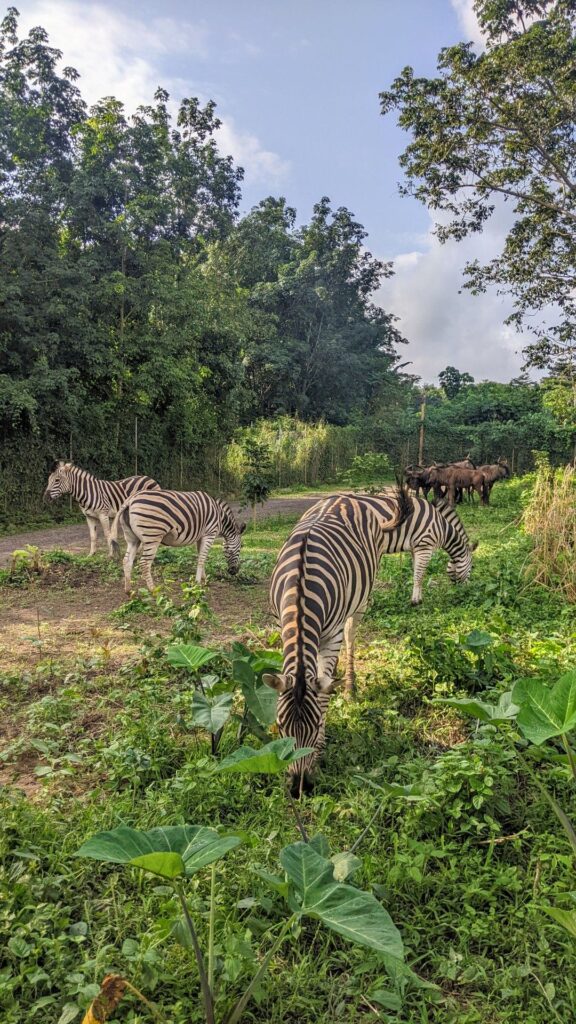
When most British travellers think safari, they think Kenya. Tanzania. South Africa. The Serengeti at sunrise, wildebeest migrations, lions on kopjes. Ghana rarely appears in that mental picture — and honestly, that’s a shame, because it means an extraordinary wildlife destination has been hiding in plain sight.
Ghana won’t give you the Big Five. Let’s be upfront about that. But it will give you forest elephants lumbering through Mole National Park, hippos lazing in the Black Volta River, one of West Africa’s most spectacular canopy walks through ancient rainforest, over 700 bird species including rarities that obsessive birders fly from Europe specifically to tick, and a safari experience completely free of the crowds you’ll find in East Africa.
It’s raw, it’s real, and for the right traveller, it’s absolutely unforgettable. This guide covers every major wildlife destination in Ghana — what you’ll see, how to get there, when to go, and exactly what to expect as a British visitor. If you’re still planning the broader trip, our ultimate Ghana travel guide is the best place to start.
🦁 Ghana Wildlife at a Glance
- 🐘 Elephants: Yes — Mole National Park (largest herd in West Africa)
- 🦝 Hippos: Yes — Wechiau Community Hippo Sanctuary & Mole
- 🐊 Crocodiles: Yes — Paga Crocodile Pond (you can sit on them)
- 🐒 Primates: Chimpanzees (Boabeng-Fiema), olive baboons, green monkeys
- 🦜 Birds: 700+ species — Ghana is a serious birding destination
- 🌿 Rainforest: Kakum National Park — canopy walkway at 30 metres
- 🦌 Antelope, warthogs, waterbuck, bushbuck, hartebeest: Mole NP
- 📍 Best base for north: Tamale | Best base for south: Cape Coast / Accra
Is Ghana Worth It for Wildlife? An Honest Assessment
Here’s the honest version: Ghana is not a Big Five safari destination. If you want to tick lion, leopard, rhino, buffalo, and elephant in one trip, East or Southern Africa is where you need to be.
But Ghana offers something increasingly rare in African wildlife tourism: authenticity without the crowds. Mole National Park — Ghana’s largest and most important wildlife reserve — receives a fraction of the visitors that Kenya’s Masai Mara sees in a single week. You can be on a walking safari tracking elephants with just you, your guide, and the sound of the bush. No other jeeps in sight. No convoys waiting at a kill.
For British visitors who’ve already done East Africa and want something different, or those who want wildlife genuinely integrated into a broader Ghana trip — beaches, culture, history, food — Ghana is a compelling and underrated choice. The key is managing expectations going in, and then being genuinely surprised by what you find.
Mole National Park
Ghana’s flagship wildlife destination and the crown jewel of any serious nature trip in the country. Mole covers around 4,840 square kilometres of savannah woodland in northern Ghana and is home to the largest elephant population in West Africa.
[PINTEREST_1]What You’ll See
- African savannah elephants — regularly seen at the watering holes below Mole Motel, sometimes from your bedroom balcony
- Hippos in the Black Volta River and park waterholes
- Olive baboons, green monkeys, patas monkeys
- Warthogs (everywhere — they’re practically the park’s mascots)
- Waterbuck, kob, hartebeest, bushbuck, oribi
- Crocodiles
- Over 300 bird species including ground hornbills, secretary birds, and several kingfisher species
- Occasional sightings of lions and leopards — rare but present
Safari Options at Mole
| Type | Details |
|---|---|
| Walking safari | The signature Mole experience. Armed rangers escort small groups through the bush on foot — genuine bush walking, not a Disney version. You get close. Mornings are best. From GHS 150 (~£9) per person. |
| Jeep safari | Available through the park and private operators. Covers more ground, better for serious photography. From GHS 300 (~£18) per person. |
| Self-drive | Possible with a 4WD. Roads are rough and tracks unmarked — guided safaris are strongly recommended for first visits. |
| Night drives | Available with advance arrangement. Different cast of characters — civets, genets, nocturnal birds. |
Where to Stay at Mole
- Mole Motel — the legendary lodge perched above the watering hole. The balcony view of elephants drinking below is one of Ghana’s great sights. Book very early — it fills up. Rooms from around GHS 400/night (~£24).
- Zaina Lodge — a genuinely lovely upscale tented camp near the park. The most comfortable option by a considerable margin. Prices from around $150/night.
- Camping is available within the park for the adventurous.
Getting to Mole
- From Accra by road: approximately 10–12 hours. Most visitors break the journey in Kumasi.
- By air: occasional domestic flights to Tamale (~1 hour from Mole) — check local airlines. Flying saves considerable time.
- By bus: VIP/STC buses run from Accra to Tamale, then a connection to Larabanga village (the park gateway).
- The best elephant viewing is at the watering hole below Mole Motel at dawn and dusk — you don’t even need to go on safari.
- The dry season (November–April) is best for wildlife viewing — animals congregate around water sources.
- Book Mole Motel months in advance. It’s cheap but perennially full.
- Bring cash — ATMs are nonexistent in the area. Tamale is your last reliable cash stop.
- The nearby village of Larabanga has one of the oldest mosques in West Africa — worth a 30-minute visit.
Kakum National Park
If Mole is Ghana’s safari destination, Kakum is its rainforest experience — and for many visitors, it ends up being the single most memorable thing they do in Ghana. Located just 30 kilometres north of Cape Coast, Kakum protects a precious remnant of West African tropical rainforest. We have a full dedicated guide to Kakum’s canopy walkway and wildlife — but here’s the essential version.
[PINTEREST_2]The Canopy Walkway
Seven rope bridges suspended between giant forest trees at heights of up to 30 metres above the forest floor. The walkway stretches for around 350 metres and is one of only a handful of such structures in the world. It is genuinely thrilling — the bridges sway, the forest unfolds below you, and if you’re quiet and early, the birdlife is spectacular.
It opens at 7am and the first walk of the day is by far the best — fewer people, cooler temperatures, and the forest is most active. By 10am it gets busy with school groups and tour buses. Get there early.
Wildlife at Kakum
- Forest elephants (rarely seen but definitely present — you may find tracks and dung)
- Bongo antelope — one of Africa’s most beautiful and elusive antelopes
- Giant forest hog
- Spot-nosed monkey, mona monkey, olive colobus
- Diana monkey — Ghana is one of the best places in West Africa to see this species
- Over 350 bird species including the white-breasted guineafowl (Ghana endemic) and brown-cheeked hornbill
Kakum Practical Information
| Detail | Info |
|---|---|
| Opening hours | 7am–5pm daily |
| Canopy walk fee | GHS 100 (~£6) for foreign visitors |
| Guided forest walk | Available — strongly recommended for birdwatching |
| Getting there | 30 min drive from Cape Coast; easily combined with castle visit |
| Best time to visit | Year-round; dry season (Nov–Apr) most comfortable |
| Duration | Half day minimum; full day for serious birders |
Wechiau Community Hippo Sanctuary
One of Ghana’s best-kept secrets and a genuinely special wildlife experience. Located in the far northwest near the town of Wa, the Wechiau sanctuary protects a stretch of the Black Volta River that is home to one of the few remaining hippo populations in West Africa.
This is community-based conservation at its best. Local villages manage the sanctuary themselves, the guides are local, and the revenue goes directly back into the community. You travel by dugout canoe along the river at dawn or dusk — the experience of watching a pod of hippos grazing on the riverbank at sunset, with no other tourists in sight, is something genuinely difficult to describe.
- Best viewing: October–April when water levels are lower
- Activities: Dawn and dusk canoe trips are the primary experience
- Also seen: Crocodiles, birds, and river otters
- Accommodation: Simple community guesthouses available on-site
- Getting there: Approximately 1 hour from Wa by road
Boabeng-Fiema Monkey Sanctuary
In the Brong-Ahafo region of central Ghana, two neighbouring villages have protected a patch of sacred forest for generations — not for conservation reasons, but for religious ones. The monkeys living here are considered sacred by the community and have become completely habituated to humans as a result.
The result is extraordinary: you walk into the forest and the monkeys come to you. Black-and-white colobus monkeys and Lowe’s mona monkeys descend from the trees and carry on their business as if you’re part of the furniture. There is nowhere else in Ghana — possibly nowhere else in West Africa — where you can have this kind of close, unforced encounter with wild primates.
[PINTEREST_3]- Location: Near Nkoranza, Brong-Ahafo Region — roughly halfway between Kumasi and Tamale
- Entry fee: Small community fee (~GHS 50 for foreigners)
- Best time: Morning, when monkeys are most active
- Duration: 2–3 hours is plenty
- Combine with: A Kumasi visit makes a logical route stop on the way north
Paga Crocodile Pond
We need to talk about the Paga Crocodile Pond, because it is one of the strangest wildlife experiences you will ever have anywhere in the world.
Near the town of Paga in Ghana’s Upper East Region, on the border with Burkina Faso, there is a pond full of Nile crocodiles. Sacred crocodiles, believed by the local community to harbour the souls of deceased community members. And you can sit on them.
Guides lead you to the edge of the pond, entice a crocodile out of the water with a live chicken, and then invite you to sit on its back for photographs. The crocodiles are genuinely wild — not sedated, not tamed in any conventional sense. They simply don’t attack humans, which the community attributes to their sacred status. The safety record over decades is spotless.
It is bizarre, memorable, and completely unlike anything else. If you’re in northern Ghana, it is worth the detour.
Birding in Ghana
Ghana is a serious, world-class birding destination — and it remains criminally underrated in international birding circles. Over 700 species have been recorded, including a number of West African endemics and near-endemics that are extremely difficult to find anywhere else.
Key Species to Look For
- White-breasted guineafowl — Ghana endemic, found in Kakum and Ankasa
- Rufous fishing owl — extremely rare, best chances along forest rivers
- Standard Wing nightjar — extraordinary display flights at dusk in savannah areas
- Black bee-eater, Blue-headed bee-eater — stunning and approachable
- Brown-cheeked hornbill, Yellow-casqued hornbill — unmissable in forest areas
- Copper-tailed glossy starling, Tessman’s flycatcher, Nkulengu rail
Best Birding Sites
| Location | Best for |
|---|---|
| Kakum National Park | Forest species, hornbills, guineafowl, Diana monkey (bonus) |
| Ankasa Resource Reserve | Deep forest endemics, most pristine rainforest in Ghana |
| Mole National Park | Savannah species, ground hornbills, secretary bird |
| Atewa Forest Reserve | Highland forest species, extremely biodiverse |
| Shai Hills Resource Reserve | Easy day trip from Accra, dry woodland species, baboons |
| Volta River estuary | Waterbirds, shorebirds, mangrove species |
- The dry season (November to March) is generally best — migrants are present and vegetation is lower.
- Ghana Birds (ghanabirds.com) is the go-to resource for trip reports and local guides.
- Hiring a local specialist birding guide is strongly recommended — they hear and locate birds you’ll walk straight past.
- Ankasa Resource Reserve (near Takoradi) is the top destination for serious listers but requires advance planning and a full day’s travel from Accra.
Shai Hills Resource Reserve
Often overlooked in favour of the northern parks, Shai Hills is one of Ghana’s most accessible wildlife areas — just an hour east of Accra on the main motorway. An excellent option if you only have a day or two and can’t make it north.
- Olive baboons — large troops, very habituated to visitors
- Green monkeys, patas monkeys
- Bushbuck, oribi, Maxwell’s duiker
- Ghana’s only population of ostriches (introduced)
- Excellent dry woodland birding
- Caves with colonial-era history
- Entry fee: GHS 60 (~£4) for foreigners | Hours: 6am–6pm daily
When to Go: Wildlife Season Guide
| Period | Wildlife conditions |
|---|---|
| November–February | Best overall. Dry season, cooler temperatures. Vegetation is low — animals are visible. Water sources concentrate wildlife. Peak birding with migrants present. |
| March–April | Still good. Getting hotter but dry. Last good months before rains arrive in the south. |
| May–June | Rains begin in the south. Forest greens up — harder to spot animals. Birding still excellent. Mole remains accessible. |
| July–September | Peak rains. Some park tracks become impassable. Lush and beautiful but wildlife harder to spot. Low season — cheaper and quieter. |
| October | Rains easing. Transitional month. Northern parks start to dry out and wildlife viewing improves. |
For a full breakdown of Ghana’s seasons and how they affect travel more broadly, our month-by-month Ghana weather and travel guide covers everything.
Combining Wildlife With the Rest of Your Ghana Trip
One of the great advantages of wildlife in Ghana is how well it integrates with everything else the country offers. Unlike East Africa where safari often IS the trip, Ghana lets you mix wildlife with culture, history, beaches, and cities in a way that feels completely natural.
Suggested Combinations
🌿 Southern Circuit (5–7 days)
Accra → Shai Hills (day trip) → Kakum National Park → Cape Coast Castles. Wildlife, history, and coast — all within easy driving distance of each other.
🐘 Northern Adventure (8–12 days)
Accra → Kumasi → Boabeng-Fiema → Mole National Park → Tamale → Paga. Culture, crafts, primates, and genuine bush safari. Long drives but absolutely unforgettable.
🌎 Full Ghana Loop (14–16 days)
Accra → Cape Coast (Kakum + castles) → Kumasi → Boabeng-Fiema → Mole → Tamale → Wechiau → Bolgatanga → Paga → back south. Covers wildlife, culture, history, and the extraordinary northern landscape in one epic loop.
Frequently Asked Questions
Is Ghana safe for wildlife travel?
Yes. Ghana is one of West Africa’s most politically stable and visitor-friendly countries. The northern parks are remote but not dangerous. Standard travel precautions apply — malaria prophylaxis is essential, don’t walk alone at night in unfamiliar areas, and drink bottled water throughout.
Do I need vaccinations for northern Ghana?
Yellow fever vaccination is mandatory for Ghana entry and is especially relevant for the northern savannah areas. Malaria prophylaxis is essential for all parts of Ghana. Our Ghana health and vaccinations guide for British visitors covers everything you need before travel.
Can I see the Big Five in Ghana?
No. Ghana has elephants and very small numbers of lions in Mole, but rhinos are not present and leopard sightings are extremely rare. If ticking the Big Five is your primary goal, East or Southern Africa is the right destination. Ghana is the right destination if you want something genuine, uncrowded, and different.
What should I pack for a wildlife trip in Ghana?
Lightweight long-sleeved clothing in neutral colours, good walking boots, binoculars (essential for birding), a hat and high-factor sunscreen, insect repellent with DEET, a decent camera with zoom lens, and sufficient cash — ATMs are scarce in the northern areas and Tamale is your last reliable stop before Mole.
How do I fit wildlife into a broader Ghana trip?
Very easily. A southern circuit combining Accra, Kakum, and Cape Coast takes just 5–7 days. Adding Mole to a northern loop requires 10–12 days minimum. For full trip planning, see our ultimate Ghana travel guide.
The Bottom Line
Ghana will not replace Kenya. But for the right traveller — one who values authenticity over infrastructure, discovery over set pieces, and genuine wilderness over crowds — it offers wildlife experiences that are quietly extraordinary.
Walking amongst elephants at Mole with no other tourists in sight. Swaying 30 metres above an ancient rainforest on Kakum’s canopy walkway. Gliding up the Black Volta at dusk in a dugout canoe while hippos emerge from the water 20 metres away.
Ghana has its own magic. You just have to show up to find it.