
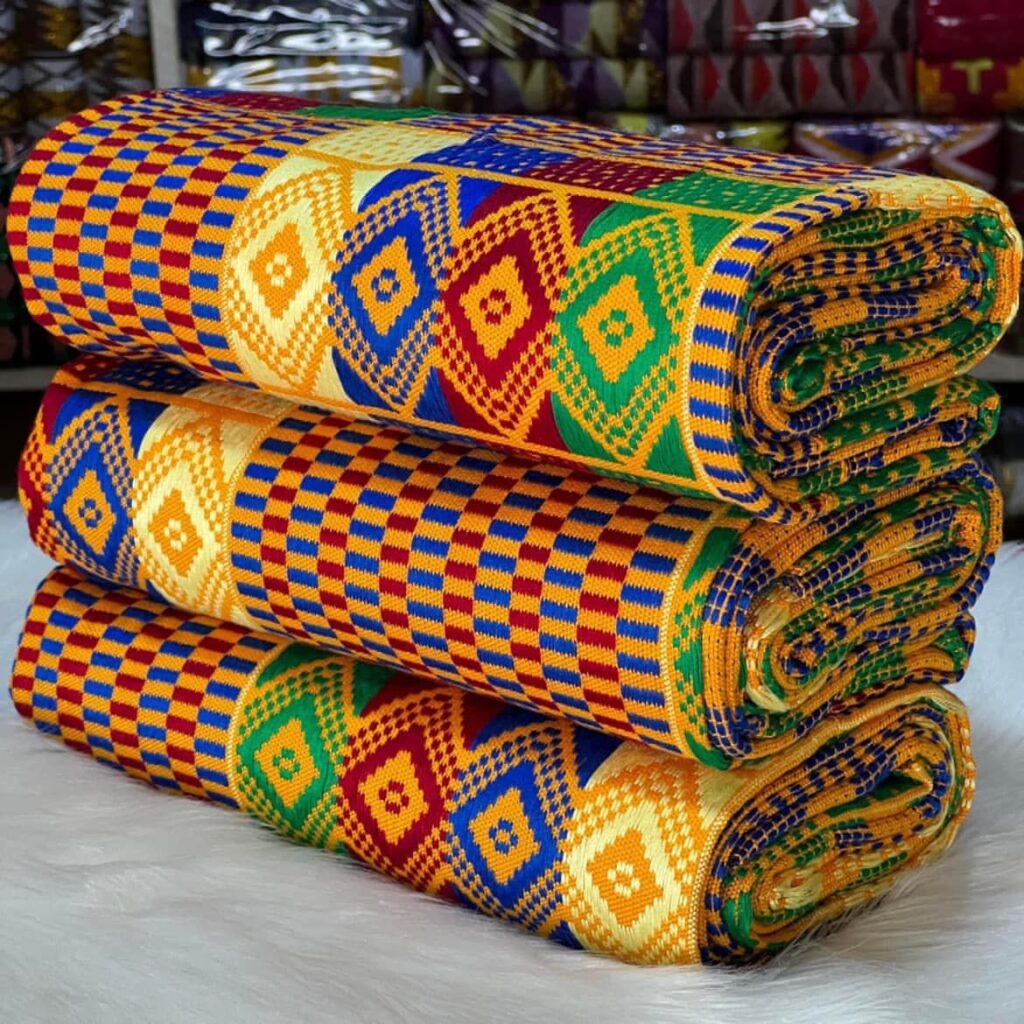
There is a moment — usually somewhere in Kumasi, or in the Kente-weaving village of Bonwire — when you see a weaver at his loom for the first time and something clicks. The strips of fabric forming under his hands are not just cloth. They are language. Each colour carries meaning. Each pattern tells a story. Every piece of Kente that has ever been woven carries the identity of its maker, its wearer, and its occasion.
Kente is Ghana’s most recognisable export — worn by presidents, adopted by the African diaspora worldwide, referenced in music, fashion, and art from New York to London to Lagos. And yet most people who admire it from afar know surprisingly little about what it actually is, where it comes from, and what it means.
This guide changes that. By the end, you’ll understand the history, the symbolism, the different types, how to spot authentic Kente, and where to buy the real thing — sourced directly from Ghanaian weavers. For a broader look at Ghanaian textiles and dress, our guide to traditional Ghanaian clothing styles and their meanings is the perfect companion read.
🧵 Kente at a Glance
- 📍 Origin: Bonwire, Ashanti Region, Ghana — traditional centre of production
- 🏛 History: Over 400 years of documented weaving tradition
- 👑 Original purpose: Reserved exclusively for Ashanti royalty and sacred occasions
- 🎨 Construction: Hand-woven strips (~4 inches wide) sewn together by hand
- 🌎 UNESCO status: Intangible Cultural Heritage of Humanity (2023)
- 💰 Authentic price range: GHS 300–5,000+ depending on complexity
- 🛒 Where to buy: Bonwire village, Kumasi markets, or our shop (coming soon)
The History of Kente Cloth
The origins of Kente weaving are traced to the Ashanti kingdom of present-day Ghana, with the tradition dating back over 400 years. According to Ashanti oral history, the technique was inspired by a spider spinning its web — two brothers named Kurugu and Ameyaw are said to have observed a spider weaving and replicated the technique using raffia fibres. When they presented their creation to the Asantehene (the Ashanti king), it was immediately adopted as royal cloth.
For centuries, Kente was exclusively the preserve of Ashanti royalty and chiefs. It was worn only on the most significant ceremonial occasions — coronations, funerals, festivals. The right to wear certain patterns was restricted, and certain combinations of colours and designs were reserved for the king alone. Commoners who wore royal Kente patterns without permission faced severe punishment.
In the 20th century, Kente travelled with the African diaspora and became a global symbol of pan-African identity. Civil rights leaders wore it. African-American graduates wear Kente stoles at ceremonies. Barack Obama received a Kente gift on his presidential visit to Ghana. The fabric has become a symbol of African dignity worldwide — while remaining, at its heart, a deeply specific, deeply Ghanaian creation. To understand the broader cultural context, our article on the role of Ashanti chiefs and traditional councils in modern Ghana gives excellent background.
How Kente Is Made
Understanding how Kente is made transforms your appreciation of it. Every strip of authentic Kente is hand-woven on a narrow-band loom by a skilled craftsman — a process that has remained essentially unchanged for four centuries.
The Weaving Process
- The loom produces strips of fabric approximately 4 inches (10cm) wide.
- Weavers — traditionally men in Ashanti culture — pass the shuttle back and forth by hand, interlacing warp and weft threads to create the pattern.
- A single strip of complex Kente can take an experienced weaver an entire day to produce.
- Multiple strips — typically 12 to 24 for a full cloth — are sewn together side by side to create the finished fabric.
- A full men’s ceremonial Kente cloth requires around 24 strips and can take a master weaver weeks to complete.
Materials
Traditional Kente was woven from silk — reserved for the most prestigious cloths. Today the most common materials are:
- Silk — still used for the finest, most expensive pieces. Has a distinctive lustre and drape.
- Rayon — more common in mid-range Kente. Provides bright colours at lower cost.
- Cotton — used in simpler pieces, especially those marketed as everyday wear.
- Mixed fibres — many contemporary pieces blend materials for a balance of quality and affordability.
The material affects both price and feel significantly. Ask when buying what the cloth is made from — a reputable seller will always know.
What the Colours Mean
Every colour in Kente carries specific symbolic meaning rooted in Ashanti cultural philosophy. Understanding the colour symbolism is essential both for appreciating the cloth and for choosing a piece that resonates with your intention.
| Colour | Symbolism |
|---|---|
| Gold / Yellow | Royalty, wealth, high status, glory, spiritual purity. The most prestigious colour in Kente. |
| Green | Growth, renewal, the land, good health, fertility. Associated with the harvest and new beginnings. |
| Red | Political and spiritual significance; blood, sacrifice, struggle. Used in times of heightened emotion. |
| Blue | Peace, harmony, love, togetherness. Also associated with the sky and the divine. |
| White | Purity, cleanliness, festivity, victory. Often worn at joyful celebrations. |
| Black | Aging, spiritual maturity, the ancestors. Not associated with mourning as in Western cultures. |
| Grey | Healing, cleansing rituals, associated with ash. |
| Maroon | The earth, healing, nourishment, mother earth. |
| Purple | Associated with feminine aspects of life — fertility, womanhood. |
| Pink | Female essence, gentleness, calmness. |
| Silver | The moon, serenity, purity, joy. |
Most Kente cloths use multiple colours, and the combination carries layered meaning. A cloth combining gold, green, and black signals prosperity, growth, and spiritual maturity — typical for a chief or elder’s ceremonial cloth.
What the Patterns Mean
Beyond colour, Kente patterns each carry their own names and meanings. There are hundreds of recognised patterns, many of them ancient, each with a name in Twi (the Ashanti language) that encodes its meaning.
| Pattern name | Meaning |
|---|---|
| Sika Futuro | Gold dust — associated with wealth and the historic Ashanti gold trade. |
| Emaa Da | “It has not happened before” — a pattern celebrating unprecedented achievement. |
| Fawohodie | Freedom and independence — widely worn at national celebrations and by the diaspora. |
| Obaakofoo Mmu Man | “One person does not rule a nation” — invoking democratic and communal values. |
| Adweneasa | “My thoughts are fully expressed” — associated with the fullness of wisdom. |
| Kyemfere | A pattern of the royal court, historically reserved for kings. |
| Nkyinkyim | Adaptability, dynamism, versatility — one of the most widely used patterns. |
| Abusua Ya Dom | “The family is a force” — unity, togetherness, community strength. |
When buying Kente, asking the weaver or seller to explain the pattern name and meaning deepens the connection between you and the cloth enormously. A piece of Kente with a meaning that resonates with your life becomes something far more personal than a souvenir.
Types of Kente Products
| Product | Description |
|---|---|
| Full cloth (men’s) | 24 strips, ~12 feet long. Worn draped over the shoulder like a toga. For ceremonial occasions. The most prestigious and expensive form. |
| Full cloth (women’s) | Typically two pieces — a wrap skirt and a top piece. Also ceremonial. |
| Kente stole | A single long strip worn over academic gowns or suits. Hugely popular with the diaspora. Affordable entry point. |
| Kente scarf | Narrower, lighter, versatile. Works as a headwrap, neck scarf, or bag accessory. |
| Kente fabric by the yard | Sold in markets for tailoring into custom clothing. Many Ghanaian tailors in the UK can work with it. |
| Kente accessories | Bags, wallets, phone cases, bow ties, cushion covers. Quality varies widely — check the weave carefully. |
| Kente jewellery | Earrings, bracelets, and pendants incorporating Kente strips or woven patterns. |
We are building a curated shop of authentic Ghanaian-made Kente — sourced directly from weavers in Bonwire and Adanwomase. Stoles, scarves, fabric by the yard, and accessories. All verified hand-woven.
Coming Soon — Notify MeAuthentic vs Fake Kente: How to Tell the Difference
The global popularity of Kente has created a large market for imitation. Machine-printed fabric designed to look like Kente is mass-produced in China and elsewhere and sold cheaply across West Africa and online. Knowing the difference matters — both for your investment and for the artisans whose livelihoods depend on authentic craft.
Signs of Authentic Hand-Woven Kente
- Woven in narrow strips: Authentic Kente is made of strips approximately 4 inches wide sewn together. You can see and feel the seam lines on the back.
- Slight irregularities: Hand-weaving means slight variations in tension and alignment. Perfect geometric regularity is a sign of machine production.
- Texture and weight: Authentic Kente has a firm, structured hand-feel. Machine-printed fabric feels flat and thin by comparison.
- The reverse side: Turn the cloth over. Authentic woven Kente has a clearly different reverse side where the weave structure is visible. Printed fabric looks the same on both sides.
- Price: Authentic hand-woven Kente is not cheap. A genuine stole starts at around GHS 150–300. A full cloth costs hundreds of dollars. If the price seems too good to be true, it is.
- Ask where it was made: A reputable seller will tell you exactly where their cloth comes from — Bonwire, Adanwomase, or another recognised weaving village.
- Much of what is sold as “Kente” globally — including online — is machine-printed fabric with a Kente-inspired pattern.
- This is not the same as hand-woven Kente. It has no cultural heritage, no craft value, and no artisan behind it.
- There is nothing wrong with Kente-print as a fashion choice — but know what you are buying.
- If you want authentic hand-woven Kente, buy from verified sources that can trace the cloth to a named weaver or village.
Where to Buy Authentic Kente
In Ghana
- Bonwire — the spiritual home of Kente weaving, about 20km from Kumasi. Watch weavers at work and buy directly. Prices are fair, authenticity is guaranteed.
- Adanwomase — another major weaving village near Kumasi, slightly less touristy than Bonwire and often with better prices.
- Kumasi Central Market (Kejetia) — the largest market in West Africa. Huge range of Kente available. Bargaining expected. Apply the authenticity checks above carefully.
- National Cultural Centre, Kumasi — curated craft market with generally reliable quality and clearly labelled pricing.
- Accra Arts Centre — popular with tourists. Wide selection but some machine-made items mixed in. Inspect carefully.
If you’re planning a trip to Kumasi, our ultimate Ghana travel guide covers how to get there and what else to see while you’re in the city.
Online
- Look for sellers who explicitly state hand-woven and can name the weaving village or artisan.
- Etsy has a number of legitimate Ghanaian sellers — read reviews carefully and ask questions before purchasing.
- Avoid mass marketplace listings with dozens of identical items at very low prices — these are almost always machine-printed.
Skip the guesswork. Our shop will carry only verified hand-woven Kente sourced directly from artisans in Bonwire and Adanwomase. Every piece traceable to its maker.
Coming Soon — Notify MeHow to Wear and Care for Kente
Wearing Kente
For most British buyers, the most wearable formats are:
- Kente stoles worn over formal clothing — suits, academic gowns, dresses — for celebrations, graduations, or cultural events.
- Kente scarves styled as headwraps, neck accessories, or bag ties.
- Custom-tailored garments made from Kente fabric — jackets, shirts, dresses. Many Ghanaian tailors in the UK can work with Kente fabric.
Caring for Kente
- Hand wash only in cold water with mild detergent. Machine washing damages the weave structure over time.
- Do not wring — press gently in a towel and lay flat to dry away from direct sunlight.
- Iron on low heat on the reverse side. High heat can damage silk and rayon threads.
- Store folded (not hung) to prevent stretching at the seams.
- For display pieces, frame under UV-protective glass to prevent colour fading.
Kente as a Gift
Kente makes a genuinely meaningful gift — one with a story behind it that most recipients won’t have heard before.
- A Kente stole for a graduation or academic achievement — a tradition with deep roots in the African diaspora, increasingly common in the UK.
- A Kente scarf for someone who loves textiles or has a connection to Ghana or West Africa.
- A framed Kente strip — a striking piece of wall art that sparks conversation.
- Kente accessories (wallet, bag, bow tie) for someone who wants the fabric in everyday life without wearing a full cloth.
- A personalised commission — a Ghanaian weaver can create a cloth incorporating patterns with meaning specific to that person’s life stage or values.
Our shop will offer curated authentic Kente gifts — stoles, scarves, accessories, and commissioned pieces — all sourced directly from Ghanaian artisans. Gift wrapping and certificates of authenticity included.
Coming Soon — Notify MeFrequently Asked Questions
Is it cultural appropriation to wear Kente?
This question comes up often. The consensus among Ghanaians themselves is largely welcoming — Ghana actively promotes its cultural exports and most Ghanaians are pleased when foreigners engage respectfully with Kente. The key word is respectfully: wearing Kente as a fashion accessory is generally fine; wearing sacred or royal patterns at inappropriate occasions is less so. When in doubt, choose a simpler pattern and buy from a source that educates you about what you’re wearing.
What’s the difference between Kente and Ankara fabric?
A very common confusion. Kente is hand-woven in Ghana using a specific weaving tradition with over 400 years of history. Ankara (also called African wax print) is machine-printed cotton fabric originally produced in the Netherlands and later China, designed to appeal to African tastes. Ankara is beautiful in its own right — but it is not Kente. They are completely different products with different origins and production methods. Our guide to Ghanaian clothing styles and their meanings covers both in more detail.
Can I commission a custom Kente cloth?
Yes, and it is one of the most meaningful things you can do with Kente. Master weavers in Bonwire and Adanwomase can create cloths to specification — choosing colours, patterns, and incorporating personalised symbolic meaning. Custom commissions take time and cost more, but the result is a one-of-a-kind piece. Our shop will offer commission services when it launches.
How do I know what pattern to choose?
Let the colour and pattern symbolism guide you — choose colours that reflect your values or what you want to embody. If buying as a gift, consider the recipient’s life stage and values. If you’re visiting Ghana, ask the weaver directly — they will often suggest patterns based on a short conversation. This is part of what makes buying directly from artisans so valuable.
What does Kente have to do with Ghana’s festivals?
Kente and Ghana’s festivals are deeply intertwined — you’ll see the most spectacular displays of traditional cloth at events like Akwasidae, PANAFEST, and Homowo. Our Ghana festivals calendar will help you time your trip to see Kente at its most magnificent.
The Bottom Line
Kente is not just fabric. It is one of the world’s great textile traditions — a 400-year-old living art form that carries the history, philosophy, and identity of an entire people within its threads.
Whether you encounter it first at a market stall in Kumasi, watch it being woven in Bonwire, or receive it as a gift from a Ghanaian friend, the moment you understand what you’re looking at, Kente becomes something you see completely differently.
Buy authentic. Buy with knowledge. And wear it — or display it — with the pride it deserves.
Hand-woven Kente sourced directly from artisans in Ghana’s weaving villages. Stoles, scarves, fabric, accessories, and commissioned pieces. Every item verified and traceable to its maker.
Notify Me When the Shop Opens