
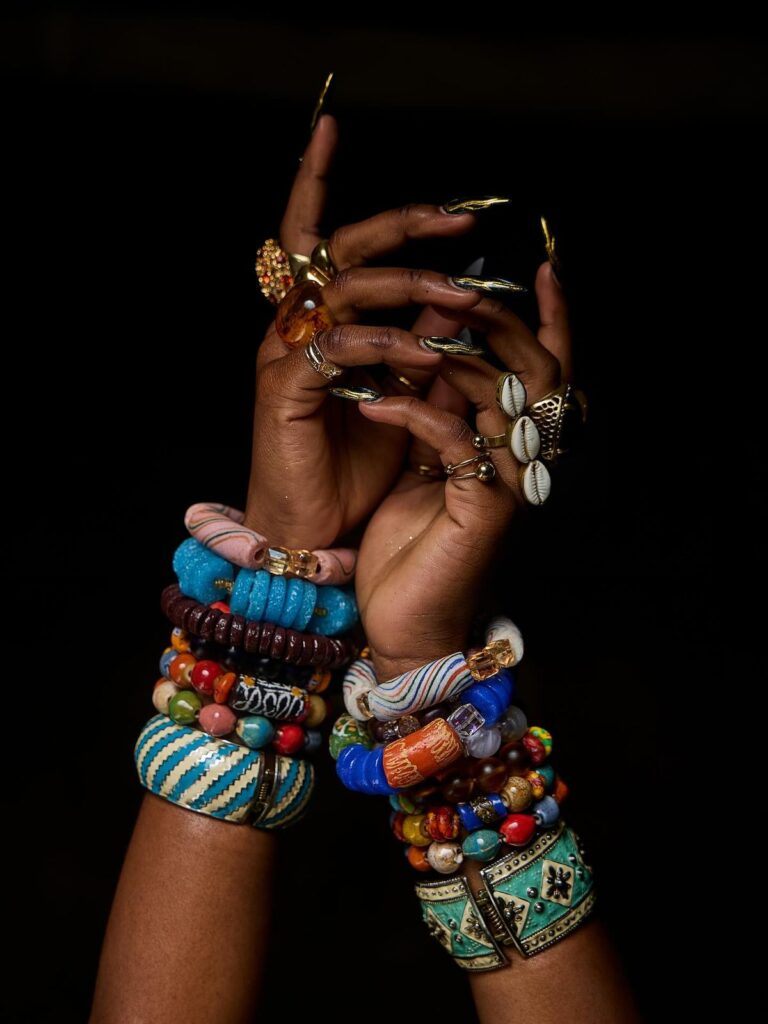
There is a type of jewellery being made in a small town in eastern Ghana that has been quietly captivating collectors, designers, and travellers for decades. It doesn’t come from a factory. It isn’t produced by machines. It is made bead by bead, by hand, using techniques passed down through generations of Krobo women, from glass that has been crushed, moulded, and fired in clay pots over open flames.
Krobo beads are Ghana’s most extraordinary jewellery tradition — and one of the most compelling craft stories in the world. They have been traded across West Africa for centuries, worn by queens and chiefs, used as currency, and incorporated into some of the most important ceremonies in Ghanaian cultural life. Today they are collected by galleries in New York, London, and Paris, featured in international fashion editorials, and sought out by travellers who know what they’re looking for.
This guide tells the full story — the history, the making, the meaning, the different types, how to spot authentic pieces, and where to buy genuine Krobo beads both in Ghana and in the UK. If you’re planning a trip to source them yourself, our ultimate Ghana travel guide is the best place to start planning.
💎 Ghanaian Jewellery & Krobo Beads at a Glance
- 📍 Origin: Krobo people, Eastern Region of Ghana (Odumase-Krobo & surroundings)
- 🏛 History: Over 300 years of documented bead-making tradition
- 🔥 Material: Recycled glass — bottles, windows, windscreens — ground and re-fired
- 👩🏾 Made by: Krobo women, using techniques passed down through generations
- 🎨 Style: Intensely colourful, geometric patterns, endlessly varied designs
- 💰 Price range: £5–£200+ depending on age, complexity, and authenticity
- 🛒 Best places to buy: Odumase-Krobo town, Accra craft markets, verified online sellers
- 🎁 Perfect for: Necklaces, bracelets, earrings, statement pieces, gifts, collecting
Who Are the Krobo People?
The Krobo are an ethnic group indigenous to the Eastern Region of Ghana, centred around the Krobo Mountain and the towns of Odumase-Krobo and Somanya. They are one of the Dangme-speaking peoples of Ghana, closely related to the Ga people of the Greater Accra region.
The Krobo have a rich and distinctive culture — their most famous ceremony is the Dipo, a coming-of-age initiation rite for young women that marks the transition from girlhood to womanhood. Beads are central to this ceremony and to Krobo identity more broadly. A Krobo woman’s bead collection is one of her most prized possessions — accumulated over a lifetime, worn at ceremonies, and passed down to daughters and granddaughters as heirlooms. You can learn more about Ghanaian cultural ceremonies in our guide to Ghana’s unique celebration traditions.
Bead-making and bead trading have historically been central to Krobo economic life. The Krobo were famously skilled traders, travelling far beyond their home territory to sell their beads across West Africa. Their beads were so valued that they were used as currency — a strand of quality Krobo beads could buy land, settle debts, or serve as bride price.
The History of Krobo Bead-Making
The origins of Krobo bead-making are rooted in trade. Ghana was a major hub of the transatlantic and trans-Saharan trade networks, and European traders brought vast quantities of glass trade beads to West Africa from the 17th century onwards — Venetian chevron beads, Dutch powder glass beads, Bohemian faceted beads. These beads flooded into West African markets and became enormously valued as currency and adornment.
The Krobo did something remarkable: rather than simply trading in imported beads, they began making their own. Using broken and discarded European glass — bottles, windows, mirror fragments — they developed a technique for grinding the glass into powder, pouring it into clay moulds, and firing it to create entirely new beads. This powder glass technique became the foundation of Krobo bead-making and remains essentially unchanged today.
Over time, the Krobo developed their own distinctive aesthetic — layered geometric patterns, intense colours, complex surface decorations applied with fine tools. What began as a practical response to available recycled glass evolved into one of the most sophisticated bead-making traditions anywhere in the world.
Today, Krobo beads are recognised internationally as significant cultural artefacts. The Smithsonian Institution in Washington holds Krobo beads. The British Museum has examples in its African collection. And in Odumase-Krobo, the tradition continues — women sit at their workshops, grinding glass, filling moulds, and firing beads exactly as their grandmothers did.
How Krobo Beads Are Made
The powder glass technique is one of the most tactile and visually captivating craft processes you can witness. If you visit Odumase-Krobo, watching a bead-maker at work is an experience not easily forgotten.
The 9-Step Powder Glass Process
- Glass collection: The bead-maker collects recycled glass — old bottles, broken windscreens, glass fragments of all colours. Different glass produces different colours in the finished bead.
- Grinding: The glass is ground by hand using a stone mortar and pestle until it becomes a fine powder. The consistency of the powder affects the quality of the finished bead.
- Colouring: Glass powder of different colours is separated and sometimes mixed to create new colours and effects.
- Mould preparation: Clay moulds are prepared with small cylindrical holes of the desired bead size. A cassava stalk is placed in the centre of each hole to create the threading hole.
- Filling: The glass powder is carefully spooned into the clay moulds. For patterned beads, powders of different colours are layered or arranged in patterns at this stage.
- Firing: The filled moulds are placed in a small kiln or over an open fire and heated until the glass powder melts and fuses. Temperature and duration must be precisely controlled.
- Cooling and removal: The moulds cool, then beads are removed. The cassava stalk burns away during firing, leaving the threading hole.
- Decoration: Many Krobo beads receive additional decoration after the initial firing — fine lines, dots, and patterns are painted with liquid glass and the bead is re-fired to fuse the decoration permanently.
- Finishing: The beads are polished, sorted by hand, and matching beads are assembled into strands.
A skilled bead-maker can produce dozens of beads per day for simple designs, but complex, heavily decorated pieces may take an hour or more each. The most intricate collector’s pieces are true works of art.
Types of Krobo Beads
| Type | Description |
|---|---|
| Powder glass (standard) | The classic Krobo bead — made using the traditional powder glass technique. Comes in an enormous variety of colours, sizes, and patterns. The foundation of the tradition. |
| Bodom beads | Large, ceremonial beads traditionally made from yellow glass. Historically among the most valuable, used in Dipo ceremonies. Genuine antique Bodom beads are rare and expensive. |
| Kiffa-style beads | Powder glass beads with extremely fine geometric surface decoration. Named after a similar style from Mauritania — Krobo makers have developed their own exceptional version. |
| Recycled trade beads | Old European trade beads (Venetian, Dutch, Bohemian) re-strung alongside Krobo-made beads. Mixed strands of antique and contemporary pieces are common and collectible. |
| Painted beads | Beads with painted rather than fused surface decoration. Generally less durable and valuable — the paint can chip over time. Easy to spot: the decoration feels slightly raised. |
| Contemporary designer beads | Modern Krobo beads made by younger artisans experimenting with new colours, shapes, and surface treatments. Some are extraordinary; quality varies widely. |
The Role of Beads in Krobo Culture
To understand Krobo beads fully, you need to understand their place in Krobo life. These are not merely decorative objects — they are loaded with cultural, spiritual, and social significance.
The Dipo Ceremony
The Dipo is the Krobo coming-of-age ceremony for young women — one of the most visually spectacular cultural events in Ghana. Over several days, initiates are adorned with elaborate bead displays — waist beads, neck beads, arm beads, head beads — each type with its own significance. The quantity and quality of a girl’s beads reflects her family’s status and wealth. The Dipo beads a woman wears at her initiation often become her most treasured possessions for life.
Waist Beads
Waist beads are an intimate and personal form of Krobo bead use — strands worn around the waist, under clothing, invisible to most people. They carry multiple meanings: as adornment, as a measure of body awareness, as a symbol of femininity, and in some traditions as spiritual protection. The practice of wearing waist beads is common across many West African cultures but is particularly associated with the Krobo.
Beads as Heirlooms
For Krobo families, significant bead collections are family treasures — passed from mother to daughter across generations. Antique beads from colonial-era trade networks are particularly prized. A grandmother’s strand of 19th century Venetian trade beads, re-strung alongside Krobo powder glass, is simultaneously a piece of jewellery and a family history.
Authentic vs Tourist-Quality Krobo Beads
The Krobo bead market has a wide quality spectrum. Here’s how to navigate it with confidence:
Signs of Authentic, High-Quality Krobo Beads
- Made using powder glass technique — you can see the fused glass structure when you look closely at the bead surface.
- Surface decoration is fused into the bead — run your finger across the surface; decoration should feel flush, not raised or prone to flaking.
- Slight irregularities in shape and size — handmade beads are never perfectly uniform. Machine-perfect beads are machine-made.
- Vibrant, deep colours — quality glass beads hold their colour indefinitely. Cheap dyed beads fade quickly.
- The seller can name the source — ideally the specific workshop or town. ‘Made in Odumase-Krobo’ is a good sign.
- Weight — genuine glass beads have a satisfying weight. Plastic imitations feel noticeably lighter.
What to Watch Out For
- Plastic beads sold as glass — use the bite test (see below).
- Mass-produced ‘African style’ beads from China — very cheap, very uniform, low-quality glass or plastic. Widely available in tourist markets.
- Painted beads presented as fused — scratch gently in an inconspicuous spot. Paint scratches; fused glass decoration does not.
- Inflated prices for ordinary pieces — some sellers charge collector prices for standard production beads. Know the price guide before you shop.
- Gently tap the bead against your front teeth.
- Glass beads feel cool, smooth, and hard — they make a faint clicking sound.
- Plastic beads feel slightly warm and produce a duller, softer sound.
- This simple test works reliably and won’t damage the bead.
- Don’t feel self-conscious doing it — experienced bead buyers do it routinely.
Other Ghanaian Jewellery Traditions
Krobo beads are the headline act, but Ghana has several other remarkable jewellery traditions worth knowing about:
Ashanti Gold Jewellery
The Ashanti kingdom was built on gold — Ghana was literally called the Gold Coast by European traders. Traditional Ashanti jewellery — rings, pendants, bracelets, breastplates — was cast using the lost-wax technique (cire perdue), in which a wax model is encased in clay, fired to burn out the wax, and filled with molten gold. The resulting pieces are extraordinarily detailed and carry their own symbolic significance. To understand the broader Ashanti cultural context, our article on Ashanti chiefs and traditional councils is excellent background reading.
Akan Brass Castings (Gold Weights)
The Akan people developed an extraordinary tradition of small brass castings — geometric and figurative — originally used as weights for measuring gold dust. These are now primarily collected as art objects and make exceptional gifts for anyone interested in African art. Available in Accra and Kumasi markets.
Contemporary Ghanaian Jewellery Design
A new generation of Ghanaian jewellery designers is producing genuinely exciting contemporary work — combining traditional materials (Krobo beads, Ashanti gold techniques, brass casting) with modern design sensibilities. Look out for them in Accra’s boutique shops and the Accra Arts Centre.
Where to Buy Ghanaian Jewellery
In Ghana
- Odumase-Krobo — the source. Visit the town itself and watch beads being made, buying directly from workshops. Approximately 1.5 hours from Accra by road. Prices are the best you’ll find anywhere. Our Ghana transport guide covers how to get there.
- Cedi Bead Industry, Odumase-Krobo — one of the best-known bead workshops, welcoming to visitors with an excellent selection of authentic pieces. Named after founder Cedi, whose family has been making beads for generations.
- Accra Arts Centre — the largest craft market in Accra. Wide selection of Krobo beads alongside other Ghanaian crafts. Quality and price vary — apply the authenticity checks above carefully.
- Kumasi Central Market (Kejetia) — strong selection of beads and gold jewellery. Best for Ashanti gold pieces.
- Boutique shops in Osu and Labadi, Accra — several good independent shops stock quality contemporary Ghanaian jewellery alongside authentic traditional pieces.
Online
- Etsy — several legitimate Ghanaian sellers operate here. Look for sellers who photograph individual pieces, describe the bead-making process, and can name the workshop or town of origin.
- Specialist African craft retailers — a number of UK-based retailers specialise in authentic West African crafts and can vouch for provenance.
- TourispotGhana shop (coming soon) — a curated selection of authentic Krobo beads sourced directly from workshops in Odumase-Krobo. Every piece verified, every maker named.
We are building a curated shop of authentic Krobo beads and Ghanaian jewellery, sourced directly from workshops in Odumase-Krobo. Every piece verified, every maker named.
Coming Soon — Notify MePrice Guide: What to Expect to Pay
| Item | Typical price range (GBP) |
|---|---|
| Simple Krobo bead bracelet (contemporary) | £5–£15 |
| Krobo bead necklace (single strand) | £12–£35 |
| Multi-strand statement necklace | £30–£80 |
| Krobo bead earrings | £8–£25 |
| Antique / vintage Krobo or trade bead strand | £40–£200+ |
| Rare antique Bodom ceremonial beads | £100–£500+ per bead |
| Contemporary Ghanaian designer jewellery | £25–£150+ |
| Akan brass gold weight | £15–£60 |
Krobo Beads as Gifts
Krobo beads make exceptional gifts — they have a story, a visual impact, and a cultural weight that mass-produced jewellery can never match:
- A statement necklace — bold, colourful, and genuinely striking. Works with Western dress in a way that many traditional craft items don’t.
- A bracelet set — stack three or four Krobo bead bracelets for a gift that feels generous without being expensive.
- Waist beads — a deeply personal and meaningful gift for someone with a connection to West African culture or the adornment tradition.
- A collector’s strand of antique beads — for someone who appreciates history and craft, a mixed strand of antique trade beads and vintage Krobo beads is genuinely extraordinary.
- Earrings — a lighter, more everyday version of the tradition. Excellent for someone who might find a full necklace too bold.
Our shop will carry authentic Krobo beads in every form — necklaces, bracelets, earrings, waist beads, and collector’s strands. All sourced directly from Odumase-Krobo workshops. Gift packaging included.
Coming Soon — Notify MeFrequently Asked Questions
Are Krobo beads really made from recycled glass?
Yes — this is genuinely what makes them remarkable. Old bottles, broken windscreens, discarded glass of all kinds is collected, ground into powder, and transformed into these vivid, intricate beads. The tradition of recycling glass into beads developed as a practical response to the availability of European trade glass in West Africa, and has endured because the results are so beautiful. It is also, incidentally, a remarkably sustainable craft tradition.
How old are antique Krobo beads?
Genuinely antique Krobo beads can be several hundred years old, though most pieces described as ‘antique’ in markets are from the late 19th or early 20th century. The oldest and most valuable pieces are the large ceremonial Bodom beads, some dating to the 17th and 18th centuries. Authenticating true antiques requires expertise — if you’re spending significant money on beads claimed to be antique, buy from a reputable specialist.
Can I visit the bead workshops in Odumase-Krobo?
Yes, and it is one of the most rewarding half-day trips you can make from Accra. Odumase-Krobo is approximately 1.5 hours from Accra by road. Cedi Bead Industry is the most well-known and visitor-friendly workshop — you can watch every stage of the bead-making process and buy directly from the makers. Our Ghana transport guide covers how to get around.
What is the significance of waist beads?
Waist beads have multiple meanings across West African cultures. For Krobo women specifically, they are connected to femininity, body awareness, and coming-of-age traditions. In contemporary culture, waist beads have been adopted more widely by women of the diaspora as a personal adornment practice with connections to African heritage. Wearing waist beads without Krobo heritage is generally considered respectful if done with genuine awareness and appreciation of the tradition.
Do Krobo beads fade?
Quality powder glass Krobo beads do not fade — the colours are fused into the glass during firing and are essentially permanent. Painted beads (where decoration is applied after firing) can fade and chip over time. This is one of the reasons the fused powder glass technique produces superior, longer-lasting pieces — and why it’s worth paying a little more for the real thing.
What else should I buy in Ghana?
Krobo beads pair beautifully with other Ghanaian crafts. Our guide to traditional Ghanaian clothing styles covers Kente cloth and other textiles worth bringing home, and we have full guides on what to see and do across Ghana.
The Bottom Line
Krobo beads are one of the world’s great craft traditions — born from ingenuity, sustained by generations of skilled women, and producing objects of genuine beauty and cultural depth. A piece of authentic Krobo jewellery is not a souvenir. It is an object with a story that stretches back centuries, made by hand by someone who learned the craft from her mother, who learned it from hers.
Whether you discover them in a Krobo workshop in Odumase, at the Accra Arts Centre, or through our shop, the moment you hold a real Krobo bead in your hand — feel its weight, trace its patterns, understand what it took to make it — you’ll understand why collectors have been captivated by them for decades.
Buy authentic. Buy with knowledge. And wear them with the pride of someone who knows exactly what they’ve got.
Authentic Krobo beads sourced directly from workshops in Odumase-Krobo. Necklaces, bracelets, earrings, waist beads, and collector’s strands. Every piece verified, every maker named.
Notify Me When the Shop Opens