
The Asante Kingdom: A Complete History
From a loose confederation of chiefs in the forest interior of West Africa, the Asante built one of the most powerful, wealthy, and culturally sophisticated kingdoms the continent has ever seen. They defeated the British three times in open warfare, resisted colonisation for nearly two centuries, and their kingdom survives today as a living institution. This is their story in full.
The Asante story is one of the great narratives of African history and one that very few visitors to Ghana know before they arrive. It is a story of extraordinary political innovation, military genius, commercial sophistication, artistic achievement, and ultimately a confrontation with British imperial power that lasted nearly eighty years and produced some of the most dramatic chapters in West African history.
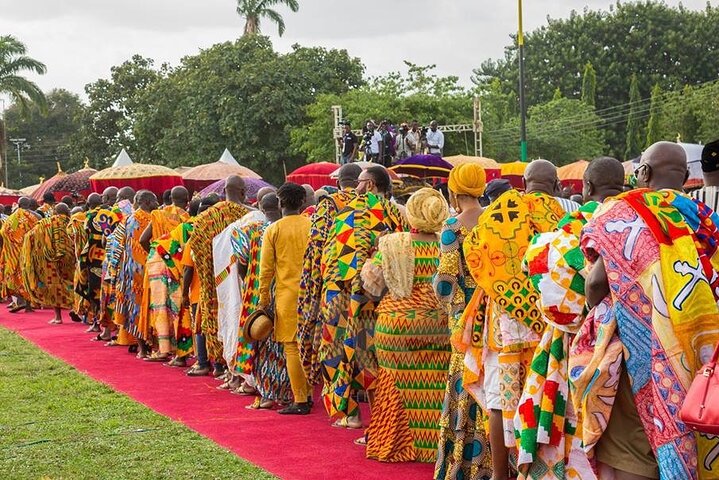
Understanding the Asante changes what you see when you walk through Kumasi. The gold jewellery in the market windows is not decoration: it is the continuation of a goldsmith tradition that equipped one of Africa’s greatest kingdoms. The chief sitting in state under a large umbrella at a festival is not a ceremonial relic: he is part of a governance system that has been operating continuously for over three hundred years. The Kente cloth woven in the villages outside Kumasi was the cloth of kings before it was the cloth of graduation ceremonies in American universities.
Origins: The Akan Peoples Before the Asante Kingdom
The Asante are the largest group within the broader Akan people, who have inhabited the forest zone of present-day Ghana for at least a thousand years. The Akan spoke related dialects of the Kwa language family, shared broadly similar cultural practices, and organised themselves in matrilineal clans where identity, inheritance, and political succession passed through the mother’s line.
Before the Asante Kingdom emerged, the Akan lived in a patchwork of small chiefdoms that competed, traded, and sometimes fought with each other. The dominant power in the region during the 17th century was the Denkyira Kingdom, which had grown wealthy by controlling trade routes between the interior gold-producing regions and the European trading posts on the coast. The Asante chiefdoms were among those required to pay tribute to Denkyira, a subordination that would prove temporary and whose ending would transform the history of West Africa.
The key resource underlying this entire period was gold. The forest zone of what is now the Ashanti Region contained extraordinarily rich gold deposits, and control of gold meant control of trade, and control of trade meant power. The Europeans on the coast, first the Portuguese and later the Dutch, British, Danes, and others, wanted gold above all else. The Akan chiefdoms that could position themselves as intermediaries between the gold-producing interior and the coastal traders accumulated wealth and leverage that translated into political power.
The Founding: Osei Tutu I and the Golden Stool
The founding of the Asante Kingdom is dated to approximately 1701, though the political processes that created it had been building for decades beforehand. The two figures at the centre of the founding story are Osei Tutu I and Okomfo Anokye.
Osei Tutu had been sent as a young man to the courts of the Denkyira and later the Akwamu kingdoms, partly as a diplomatic hostage and partly to receive political education. He returned with military knowledge, political ideas, and allies that would prove invaluable. He became the chief of Kumasi and, through a combination of marriage alliances, military victories, and political persuasion, began to build a confederation of Asante chiefs who agreed to subordinate their local loyalties to a single Asante identity.
The Descent of the Golden Stool: The founding moment in Asante tradition is the ceremony at which Okomfo Anokye, the chief priest and political genius behind the confederation, called down the Golden Stool (Sika Dwa Kofi) from the sky. In the account preserved in Asante oral tradition, the stool descended from the heavens in a black cloud and settled into the lap of Osei Tutu I. Okomfo Anokye declared that the stool contained the spirit of the entire Asante nation, that all strength and health and welfare of the Asante depended upon it, and that if it were lost or captured, the Asante nation would sicken and die. The chiefs who had assembled agreed to swear allegiance not to Osei Tutu personally but to the stool, an inspired political move that bound the confederation to an institution rather than to a personality and ensured continuity beyond any single ruler’s death.
The Golden Stool has never been sat upon. It is not a throne but a sacred object. It has its own retinue of attendants, its own regalia, and its own ceremonies. When the Asantehene appears in public at major ceremonies, the Golden Stool is carried near him, not sat upon. When the British Governor Frederick Hodgson demanded in 1900 that the Golden Stool be brought forward so he could sit upon it as a symbol of British authority, he managed simultaneously to reveal a complete misunderstanding of Asante culture and to trigger the final Anglo-Asante war.
With the confederation established and the Golden Stool as its symbol, Osei Tutu I led the combined Asante forces against the Denkyira. The decisive battle came at Feyiase in 1701, where the Asante defeated the Denkyirahene and killed him in battle. The Denkyira Kingdom collapsed, and the Asante were suddenly the dominant power in the forest zone of the Gold Coast.
The Golden Age: Expansion and the Height of Asante Power
The century following the defeat of the Denkyira was the golden age of the Asante Kingdom. Under a succession of capable Asantehenes, the kingdom expanded in every direction, bringing under its authority most of present-day Ghana and significant portions of what is now Ivory Coast and Togo.
Military Innovation
The Asante military became one of the most effective forces in West Africa. The army was organised into a sophisticated structure with a van, a main body, a rear guard, left and right wings, and a scouts corps. The Asante were among the first West African states to make systematic use of firearms acquired through trade with Europeans on the coast, supplementing the traditional weapons of war with muskets that required constant replenishment of gunpowder and shot, which in turn drove the need for continued trade revenue.
The Asante general Opoku Ware I, who reigned from approximately 1720 to 1750, expanded the kingdom most aggressively, pushing north into the savanna states of Bono, Gonja, and Dagomba. These northern conquests gave the Asante access to trade routes that had previously been controlled by others and brought new resources, including kola nuts that were valuable commodities across the Saharan trade network, into the Asante commercial sphere.
The Political System
What makes the Asante Kingdom particularly remarkable from a political science perspective is the sophistication of its constitutional arrangements. The Asante were not a simple monarchy. The Asantehene was the paramount ruler, but real power was exercised through a council system in which the chiefs of the major divisions (Kumasi, Dwaben, Kokofu, Bekwai, Nsuta, Mampon, and others) all had recognised roles and voices.
The Asantehene could be destooled (removed from office) if the council of chiefs determined he had violated his oath or abused his authority. This actually happened several times in Asante history. The system also included the Asantehemaa, the queen mother, who had the crucial power of nominating candidates for the position of Asantehene and whose counsel was essential to any major political decision.
Below the paramount level, the chieftaincy hierarchy extended down through divisional chiefs, sub-chiefs, and village headmen to cover almost every aspect of local governance. The British colonial administration eventually learned to work through this system rather than against it, a pragmatic recognition of how deeply embedded and effective it was.
Commerce and Wealth
The Asante economy was sophisticated and diversified. Gold remained the primary currency of trade with European coastal merchants, but the Asante also traded in kola nuts (used as a mild stimulant throughout West Africa and across the Saharan trade routes), cloth, iron, and slaves captured in military campaigns. The Asante were significant participants in the Atlantic slave trade for a century and a half, selling captives taken in war to European traders on the coast in exchange for firearms, textiles, and other goods.
The gold industry was highly developed. Asante goldsmiths produced work of extraordinary technical quality, from the large ceremonial items of the royal regalia to small personal ornaments. The gold weights used to measure gold dust were themselves miniature sculptures, often representing proverbs or scenes from daily life, and constitute a remarkable artistic tradition in their own right. Many examples are in the collections of major Western museums, including the British Museum and the Smithsonian.
Key Figures of the Asante Kingdom
The Anglo-Asante Wars: Britain’s Most Persistent African Adversary
The Asante fought the British not once but six times between 1823 and 1900. In three of those conflicts, the Asante won outright or achieved their objectives. In three, Britain prevailed. No other African state gave the British such sustained and costly military resistance across such a long period.
| War | Year | Key Event | Outcome |
|---|---|---|---|
| First Anglo-Asante War | 1823 to 1831 | Battle of Nsamankow: Asante forces kill British Governor Sir Charles MacCarthy | Asante victory. Treaty of 1831 recognises Asante power. |
| Second Anglo-Asante War | 1863 to 1864 | Asante invade the coastal protectorate. British force sent to repel them is defeated by disease and Asante tactics. | Effective Asante victory. British withdraw and parliament debates their West Africa policy. |
| Third Anglo-Asante War (Sagrenti War) | 1873 to 1874 | British General Wolseley leads 2,500 British regulars and burns Kumasi | British victory. Treaty of Fomena forces Asante to cede territory and pay gold indemnity. |
| Fourth Anglo-Asante War | 1895 to 1896 | British ultimatum demands Asante accept protectorate status. Prempeh I refuses. | British occupation without major battle. Prempeh I arrested and exiled. |
| Fifth Anglo-Asante War (War of the Golden Stool) | 1900 | Governor Hodgson demands the Golden Stool. Yaa Asantewaa leads Asante resistance and besieges the British garrison in Kumasi fort. | British eventually relieve the fort and suppress the rising. Yaa Asantewaa and other leaders exiled. But the Golden Stool is never surrendered. |
The British never got the Golden Stool. Despite defeating the Asante militarily in 1900, the British never found or captured the Golden Stool. It had been hidden by loyal Asante before the British could reach it. In 1921 it was accidentally discovered by road workers, who stripped some of its ornaments. The Asante reaction to this desecration was so severe, even under colonial rule, that the British agreed to return the matter to Asante jurisdiction. In 1935, the stool was formally restored to the newly restored Asantehene. Today it remains in Kumasi, still the most sacred object in Asante culture, still never sat upon.
Why the Asante Were So Difficult for the British to Defeat
The Asante military advantages were several. Their knowledge of the forest terrain gave them an overwhelming tactical advantage over British forces operating in an unfamiliar environment. The forest zone that constituted the Asante heartland was extraordinarily hostile to European armies: supply lines were difficult to maintain, the heat was extreme, and disease was devastating. The expedition of 1863 to 1864 saw more British soldiers die of disease than combat. General Wolseley’s campaign of 1873 to 1874 succeeded partly because he timed it for the dry season and moved with extraordinary speed to minimise time spent in the forest.
The Asante also adapted. They acquired firearms systematically through trade and incorporated them into their military doctrine. They developed tactics for fighting European-style formations in forest conditions, using ambush and envelopment rather than open confrontation. And they had the considerable advantage of fighting for their homeland and their independence rather than for an empire’s commercial interests thousands of miles from home.
The Yaa Asantewaa War in Full
The War of the Golden Stool in 1900 deserves fuller treatment because it represents one of the most remarkable acts of resistance in the entire history of African confrontation with European colonialism, and because Yaa Asantewaa, the woman who led it, is among the great historical figures of the continent.
By 1900, the Asante Kingdom had been under British occupation for four years. The Asantehene Prempeh I and many senior chiefs had been arrested and exiled to the Seychelles. The British had installed a Resident in Kumasi and were in the process of extending colonial administration across the Ashanti Region.
In March 1900, the Governor of the Gold Coast, Sir Frederick Hodgson, called a meeting of the remaining Asante chiefs at Kumasi fort. His speech included a demand that the Golden Stool be produced so that he, as the representative of Queen Victoria, could sit upon it as a symbol of British sovereignty over the Asante. He apparently had no idea of the significance of what he was demanding. The Golden Stool was not a throne. It was the soul of the Asante nation. The demand was equivalent to asking the chiefs to hand over the spiritual essence of their people so that a foreign official could perform a desecrating act upon it.
The Asante chiefs said nothing at the meeting. That night, according to the accounts preserved in Asante oral tradition, a council of chiefs was held at which many spoke of the impossibility of fighting the British. At this point, Yaa Asantewaa, the Queen Mother of Edweso and the most powerful woman in the Asante political structure, stood and spoke words that have been remembered ever since:
Yaa Asantewaa’s speech, as preserved in Asante oral tradition: “Now I have seen that some of you fear to go forward to fight for our king. If it were in the brave days of Osei Tutu, Okomfo Anokye, and Opoku Ware, chiefs would not sit down to see their king taken away without firing a shot. No European could have dared to speak to chiefs of Asante in the way the Governor spoke to you chiefs this morning. Is it true that the bravery of Asante is no more? I cannot believe it. It cannot be! I must say this: if you the men of Asante will not go forward, then we will. We the women will. I shall call upon my fellow women. We will fight the white men. We will fight till the last of us falls in the battlefields.”
The chiefs voted to fight. Yaa Asantewaa was appointed commander of the Asante forces, a remarkable act in a culture where military command had always been a male role. The war that followed lasted from April to September 1900. The Asante forces besieged Kumasi fort, trapping the British garrison for months. A relief force eventually broke through, but at significant cost. Kumasi was retaken in September and Yaa Asantewaa captured in November.
She was exiled to the Seychelles, where she died in 1921 at approximately 80 years old. She never returned to Ghana. But the Golden Stool she fought to protect was never surrendered. That is her victory.
Colonial Rule and the Restoration of the Asantehene
After 1900, the Ashanti Region was formally annexed to the British Gold Coast Colony. British colonial administration was imposed, though in practice it worked largely through the existing chieftaincy system. The Asante chiefs retained significant local authority even under colonialism, administering customary law, managing land tenure, and maintaining the cultural institutions that defined Asante identity.
In 1924, after 28 years in exile, Prempeh I was permitted to return to Kumasi, first as a private citizen and then, in 1926, he was formally reinstated, though initially as paramount chief of Kumasi rather than as Asantehene of the entire confederation. The full restoration of the Asante Confederacy and the position of Asantehene came in 1935, when the British formally recognised the reconstituted Asante political structure.
The restoration was culturally significant beyond its political dimensions. The Golden Stool, which had been hidden since 1900, was formally returned to Asante custody in 1935 and received at a ceremony of great emotion. The stool had sustained 35 years of colonial occupation without surrender. Its return symbolised not the end of British power, which continued until Ghanaian independence in 1957, but the survival of the Asante spirit.
The Asante and Ghanaian Independence
Ghana’s independence in 1957 brought new complications for the Asante. The relationship between the Asante Kingdom and Kwame Nkrumah’s CPP government was tense from the beginning. The Asante had been the base of the National Liberation Movement, which opposed Nkrumah and advocated for a federal constitution that would preserve regional autonomy. Nkrumah’s centralising, pan-Africanist vision was in direct tension with the Asante’s strong sense of their own identity and their historic resistance to subordination to any external authority.
After independence, Nkrumah’s government took significant steps to reduce the power of traditional rulers, including removing their control of Native Authority funds and limiting their judicial powers. The Asante chiefs navigated this period carefully, maintaining their cultural authority even as their formal political powers were curtailed.
Successive Ghanaian governments have had varying relationships with the Asante traditional institutions. The current constitutional settlement gives the Asantehene and other traditional rulers a recognised role in Ghanaian civic life without formal political power, an arrangement that allows the monarchy to exercise moral and cultural authority while operating within a democratic framework.
The Asante Kingdom Today
The current Asantehene, Otumfuo Osei Tutu II, ascended to the Golden Stool in 1999 and has made the institution more internationally visible than at any point since the colonial era. He holds a doctorate from the University of Ghana, has been involved in peace negotiations in Liberia and Ivory Coast, has received heads of state at Manhyia Palace, and has championed causes including education funding and environmental conservation in the Ashanti Region.
The Manhyia Palace Museum in Kumasi, which sits adjacent to the current palace, documents the history of the kingdom from its founding through to the present. It is one of the best museums in West Africa for the coherence and depth of the story it tells, and visiting it before exploring Kumasi more broadly transforms everything you subsequently see.
The Odwira festival, held in October, remains the most important annual event in the Asante calendar. Chiefs from across the Ashanti Region travel to Kumasi to pay homage to the Asantehene, arriving in full regalia with their courts, musicians, and retinues. It is the most concentrated display of living Akan royal culture anywhere in the world and one of the great cultural spectacles of Africa.
For visitors: The Asante story is not over. The kingdom that Osei Tutu I founded in 1701 and that Yaa Asantewaa fought to protect in 1900 is still there, still operating, still mattering to millions of people. When you visit Kumasi, you are not visiting a historical site. You are visiting a living kingdom. Approach it accordingly.
Visit Kumasi and experience Asante history firsthand
Tourispot Ghana covers everything you need to plan a trip to Kumasi and the Ashanti Region. See our Tips and Guides and Attractions Guide for practical planning information.